

Red Teacher
Synopsis
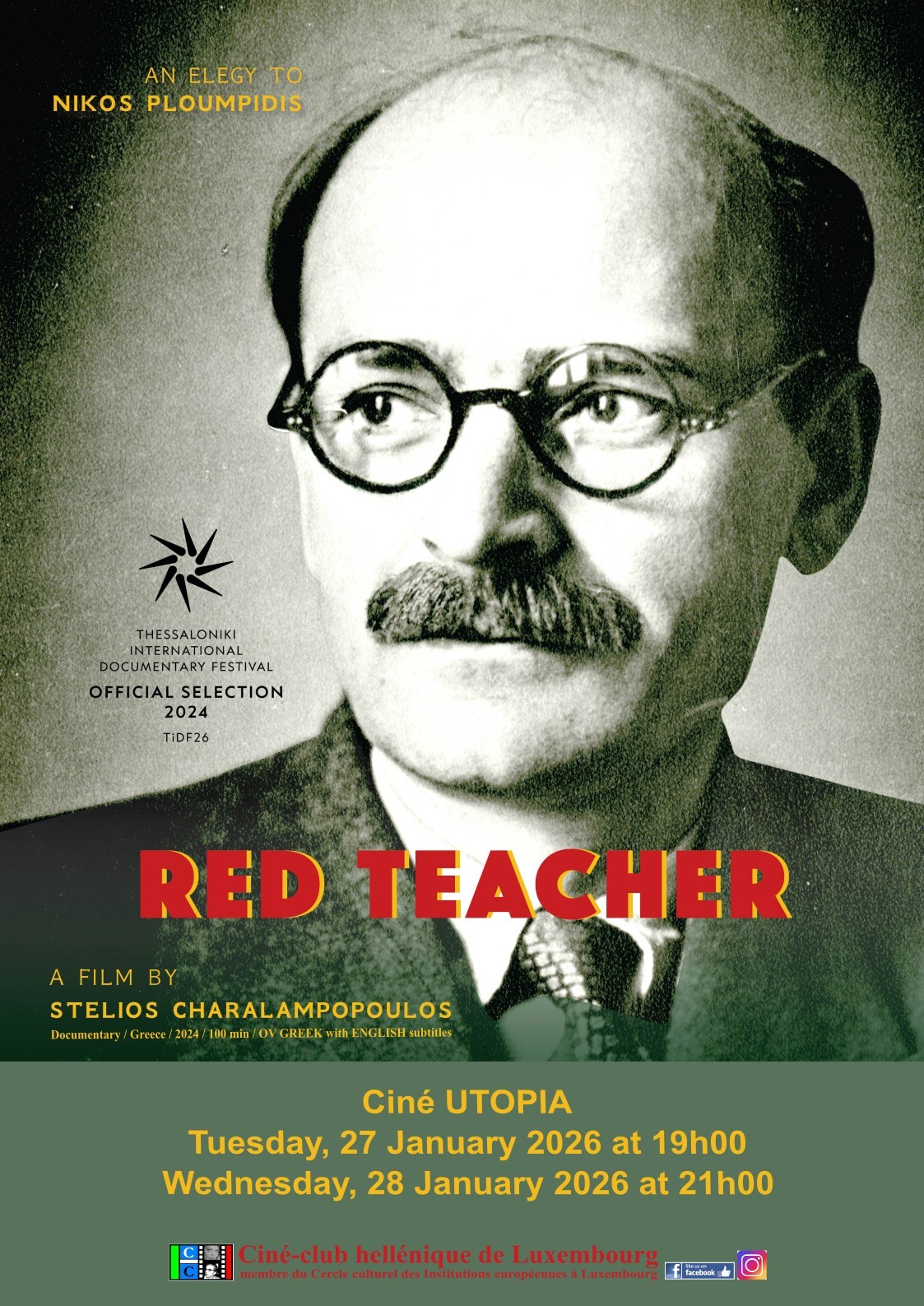
Two political trials and executions have left an indelible mark on post-conflict Greece. The trial of Nikos Belogiannis and the trial of Nikos Ploumpidis. Ploumpidis, however, died alone, slandered by enemies and friends, dishonored. Personal drama and collective destiny co-shape this Promethean hero, who seems straight out of an ancient Two political trials and executions have left an indelible mark on post-conflict Greece. The trial of Nikos Belogiannis and the trial of Nikos Ploumpidis. Ploumpidis, however, died alone, slandered by enemies and friends, dishonored. Personal drama and collective destiny co-shape this Promethean hero, who seems straight out of an ancient tragedy.
Directorial Approach
.Two political trials and executions have left an indelible mark on post-Civil War Greece. The trial of Nikos Belogiannis and his associates and the trial of Nikos Ploumbidis. Both leading figures of the then illegal Communist Party of Greece will find themselves in the midst of violent conflicts and passions and as losers of the Civil War, in the era of the Cold War in fact, they will fall victim to the vengeful mania of the victors on the one hand and to the adventurous, erratic politics of Nikos Zachariades on the other. Their parchments from the National Resistance against the occupiers will not be able to save them from the firing squad despite the outcry over the executions and the international mobilization for a pardon, especially in the case of Belogiannis.
However, History was not equally fair to both of them. Belogiannis left honored and became an idol for his comrades around the world, while Ploumbidis left alone, slandered by enemies and friends, dishonored. Although stigmatized and subject to expulsion from his party, Ploumbidis refused to renounce his principles and sign a statement of repentance, something that would have saved his life. He passionately defended his ideology and his party at the trial, even though the latter had unjustly denounced him as a scoundrel and provocateur, and was executed cheering in favor of the KKE at the same time that his comrades were issuing an announcement that the execution was staged and the traitor was enjoying the silver of his betrayal in America. After Stalin's death, the ouster of Zachariades from the leadership of the Party and especially after the 20th Congress of the CPSU and the changes underway in the international communist movement, there will be a timid rehabilitation of Nikos Ploumbidis, announced privately to his wife and years later a publication in a limited circulation party publication. Essentially, Ploumbidis remains an unhealed wound for the world of the left - at least for some part of it - and certainly if not a black, blurred page of its history.
It is characteristic of Ploumbidis' personality that quite early on, before coming into contact with leftist ideas, he rebelled against the injustice and exploitation suffered by the peasants and in the village where a teacher was first appointed, he contributed to their self-organization and struggle. At the same time, he abolished the "privileges" of the teacher, helped the needy with his meager salary, and convinced parents to send their daughters to school. Although, as he himself says, I came from a royal family, they called me a communist, without having any idea what communism was.
.The consistency with which he served his ideas, his struggles against the dictatorship of August 4 and against the German-Italian occupiers, his conviction and ability to inspire the masses resulted in the incredible mobilizations of the Athenian people to confront the occupation hunger, the black market and the political mobilization measures planned by the fascists. Virtues and achievements of Ploumbidis that received universal recognition from comrades and opponents. And yet this man will leave life with the "retsinia" of a traitor, hopelessly alone, far from his family, with the bitterness of a blatant injustice, a defenseless victim of a vulgar accusation. All these elements suggest that one should see Nikos Ploumbidis as a person who comes straight from ancient tragedy. Personal drama and collective destiny co-shape this Promethean hero who sacrifices himself for the good of the whole. The price is heavy as he will walk to death, unscathed, with only his deep belief that I am leaving my child an honest name. Literally and figuratively, a wish to future generations to restore his name.
The film The Red Teacher moves figuratively in the poetic genre of its title, passing from mourning to epic and back again. The conflict between existential suffering and the social project delimits the narrative framework and at the same time encapsulates the individual, the microhistory within the whole, in the great History. The autobiographical notes and letters that have survived, beyond being political texts, reveal to us the man, his mental world in life's limitless situations, moments of weakness but also of greatness, the heroic perseverance with which he faces his accusers, the unwavering faith in his ideals. During the trial and until his execution, Ploumbidis does not fight for his life and his posthumous fame, but for his ideas. He wants these to be presented unblemished and untainted in history. This exemplary value of ethics, an organic element of ancient tragedy, characterizes the case of Nikos Ploumbidis. With this halo he has walked until today, his story continues to arouse sadness and admiration. Ploumbidis now, without ceasing to belong to a specific historical context, simultaneously becomes a tragic figure who transcends his time, a timeless example of ethics and selflessness.
His speech in the film coexists with the speech of historians and his son, a distinguished psychiatrist, Dimitris Ploumbidis. In this way, the personal and the collective, biography and history, the moment and eternity are captured. The lens also records the spaces that played an important role in his life, spaces that emerge as living matter through his thoughts and words, through texts and people he loved. Spaces that were sometimes hospitable and sometimes of confinement and exile. At the same time, topical period, photographic material, audio and written documents illuminate the path of this emblematic figure in the first half of the turbulent twentieth century.
Trailer: https://vimeo.com/1041493688 | https://youtu.be/z3cddIYXdf0
Teasers: https://vimeo.com/1041493171 | https://youtu.be/eMB6aWKwr7s
Weiteres Films & Fotografien









Die Inhalte werden von „Echo.lu“ bereitgestellt - unverbindliche Auskünfte unter Vorbehalt von Änderungen!
Um Veranstaltungen (die auf dem Gebiet der Hauptstadt stattfinden) in unserem Veranstaltungskalender anzukündigen, müssen Sie diese zuerst auf „Echo.lu“ eintragen. Wir nehmen diese in unsere Agenda auf.